
As you may know, 2026 is the 250th birthday of our country. This year, the City of Havre de Grace would like to bring focus to significant history from Havre de Grace as part of the state and national America250 celebrations. We’ll update you as we learn more.
In the meantime, our casual historian at BAHOUKAS ANTIQUE MALL, George Wagner, will be sharing tidbits of history and stories over the coming months. He hopes you enjoy reading about them as much as he enjoys the research!
We want to give a special thank you to Robert (Bob) Magee for the notes and research given to us. The notes and research are both his and also the late Elsworth Shank, who gave many lectures through the Susquehanna Museum at the Lockhouse.
So just what is this America250 Celebration all about?
We’ll try to answer that as we share some interesting details along the way.

From the National Website: America250
On July 4, 2026, our nation will commemorate and celebrate the 250th anniversary of the signing of the Declaration of Independence. The journey toward this historic milestone is an opportunity to pause and reflect on our nation’s past, honor the contributions of all Americans, and look ahead toward the future we want to create for the next generation and beyond.
………
Across the country, Americans are planning unique and exciting ways to celebrate the 250th anniversary of the signing of the Declaration of Independence of the United States. America250 has compiled upcoming milestones and opportunities to get engaged and ensure that all Americans can find ways to commemorate this historic moment in our nation’s history.
From the America250 website
Lecture series begins with look at HdG’s Indians
From The Record, January 12, 2001, by Kathlees Gran (Record Staff)
With the beginning of the new year comes the start of the lecture series of the Susquehanna Museum of Havre de Grace at the Lockhouse.
This year, the series will chronicle the people who lived in, controlled and settled the Havre de Grace area. The first lecture in the series was Wednesday and focused on the Susquehannocks, the Native American tribe for which the Susquehanna River was named.
Ellsworth Shank, a local historian, detailed the movements of the Native Americans as they switched from dominating the area to trading with the Europeans to being reduced to a small tribe.
About 40 people listened as Shank, helped by maps, told the story of Havre de Grace before Europeans. The Susquehannocks didn’t actually live in the area but lived in a village about 40 miles to the north on the Susquehanna River. The village was inhabited by between 3,000 and 5,000 people, who used the river as their main means of transportation.
North of the Susquehannocks’ village, the area was controlled by five tribes in the Iroquois Confederacy, some of which threatened the Susquehannocks.
Shank said the Susquehannocks dominated the area throughout the 17th century until the late 1600s when they lost prominence. After 1700, he said they mixed with other tribes and by the 1800s, they were indistinguishable as an individual tribe.
The Susquehannocks were the first people to have contact with Europeans in the area and traded furs with a Virginian man who used Garrett Island, then called Palmer’s Island, as a base of operations.
Because William Claiborne was a Virginian, tension soon arose between the Susquehannocks and the officials in the Maryland colony and eventually the trading was cut off.
The Susquehannocks began to trade with the Dutch and Swedes before a treaty was signed between the Susquehannocks and Maryland officials.
In the 1660s, the tribe, along with many other Native American tribes, was hit hard by the smallpox plague.
Original Document:
Capt. John Smith’s Description of the Susquehannocks, circa 1608.
Captain John Smith, the leader of the Jamestown Colony in Virginia, wrote the first description of the Susquehannocks in English. He encountered them while exploring the northern reaches of the Chesapeake Bay in 1608. Spelling, capitalization, and punctuation have been modernized.
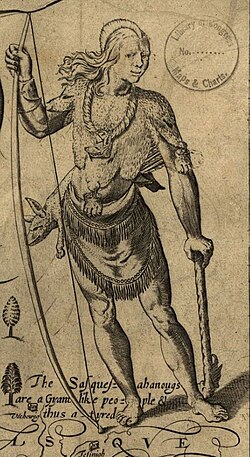
“Upon this river inhabit a people called Susquehannock. . . . 60 of those Susquehannocks came to the discoverers [Smith’s party] with skins, bows, arrows, targets, beads, swords, and tobacco pipes for presents. Such great and well proportioned men are seldom seen, for they seemed like giants to the English, yea and to the neighbors [other Indians], yet seemed of an honest and simple disposition, with much ado restrained from adoring the discoverers as gods. Those are the most strange people of all those countries, both in language and attire; for their language it may well beseem their proportions, sounding from them, as it were a great voice in a vault, or cave, as an echo. Their attire is the skins of bears and wolves; some have cassocks made of bear heads and skins that a man’s neck goes through the skin’s neck, and the ears of the bear fastened to his shoulders behind, the nose and teeth hanging down his breast, and at the end of the nose hung a bear’s paw; the half sleeves coming to the elbows were the necks of bears and the arms through the mouth with paws hanging at their noses. One had the head of a wolf hanging in a chain for a jewel, his tobacco pipe three quarters of a yard long, prettily carved with a bird, a bear, a deer, or some such device at the great end, sufficient to beat out the brains of a man, with bows and arrows and clubs suitable to their greatness and conditions. These [Indians] are scarce known to Powhatan. They can make near 600 able and mighty men and are palisaded in their towns to defend them from the Massawomeks, their mortal enemies.”
Credit: Karen Ordahl Kupperman, ed., Captain John Smith: A Select Edition of His Writings (Chapel Hill: University of North Carolina Press, 1988), 160.
The Shallop Visits Havre de Grace
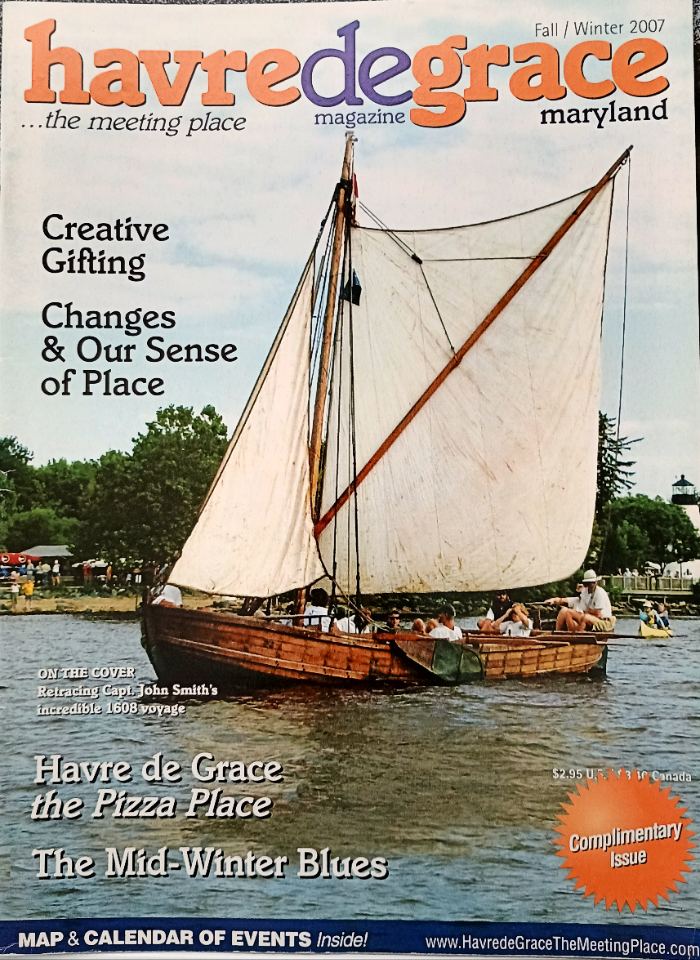
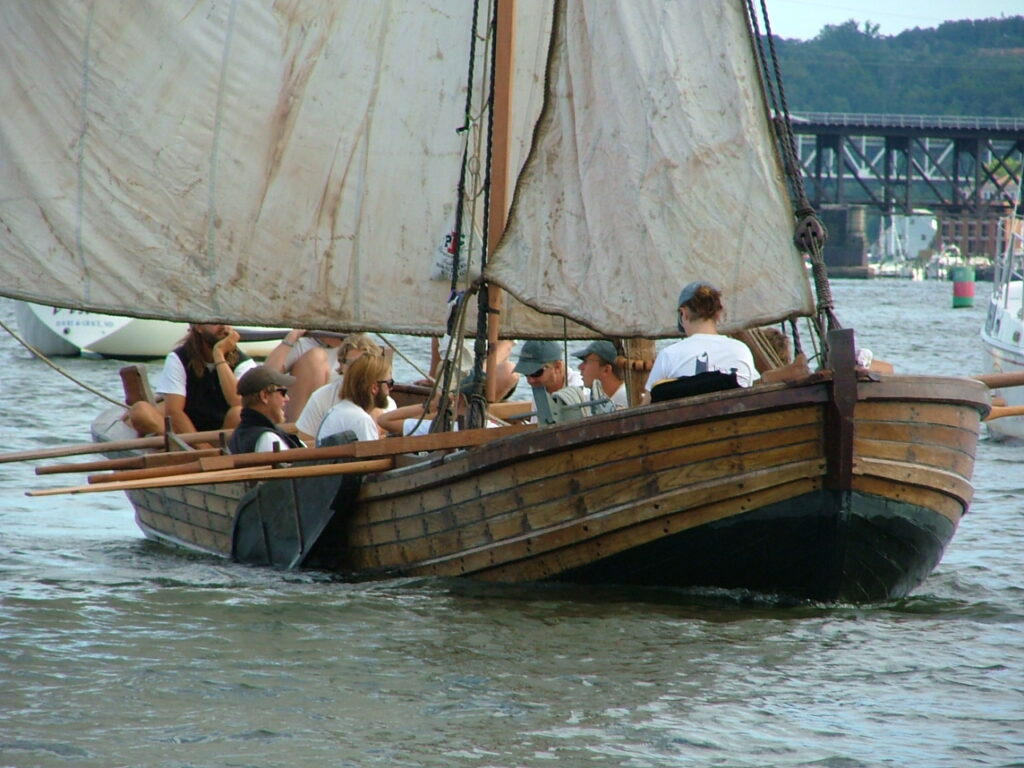
Re-Creating Capt John Smith’s Voyage of Discovery with Chris Cerino & John Mann
On May 12, 2007, a 28 ft, hand-built, open boat called a “shallop” was launched from Historic Jamestowne during festivities commemorating the settlement’s founding in 1607. Sailing and rowing, the crew retraced 1,500 miles of Smith’s 1608 exploration of the Chesapeake Bay and inaugurated the Capt: John Smith Chesapeake National Historic Trail, America’s first national historic water trail. The ship’s voyage was an educational initiative of Sultana Education Foundation, a nonprofit organization in Chestertown, Md. This is the story of their four month voyage.
This link gives you a lesson plan for anyone interested in more details about the Captain John Smith Project 400. Curriculum from the Sultana Education Foundation.
CLICK HERE for the pdf file.
Stay tuned for our next post related to Havre de Grace Celebrates America250. Stop in at BAHOUKAS ANTIQUE MALL to enjoy our Havre de Grace History Museum.